Martial arts website design that fills more trial classes.
Your mats fill by word of mouth until the month they don't. The parents doing the real research are searching at nine at night, when calling a dojo mid-class is not an option. A site of your own meets them there: programs split by age and style, a schedule with real end times, pricing that says what's included, and a trial-class form that takes the lead while you teach.
Where martial arts schools lose students
No address, no end times, no answers
One prospective student's write-up of school websites doubles as an audit checklist: no address or even neighborhood named, classes that start at 6 with no end time or length, no days listed at all. A parent comparing three schools at night does not call to fill in the blanks. The schools that answer on the page are the ones still in the running by morning.
Pricing most won't print
Plenty of school sites list no prices at all, and the ones that do are often unclear about what the monthly rate includes once kids' classes, adult programs, and a second style share the schedule. This vertical's own prospects name hidden pricing as a reason they move on. They are not haggling. They are filtering, and a missing number filters you out.
Three programs, one undifferentiated page
A school running kids taekwondo, adult BJJ, and kickboxing often presents it all as one schedule block, 6 to 10pm, with no mention of which style is taught when. Some sites never name the style at all, offering karate, kung fu, martial arts as if they were one thing. The parent of a six-year-old and the thirty-year-old hobbyist are different buyers with different questions, and a single undifferentiated page answers neither.
The web presence is a Facebook page from 2018
For many schools the only findable presence is a social page, often quiet for years, and one owner working to grow his dojo said it plainly: he had mainly been using social media. A social profile mostly reaches the people who already follow it. The parent typing kids karate and your city into a search bar has never followed anyone yet.
The only next step is a phone number
In one school-owners' thread, the advice was to offer more than a telephone number: a system where a prospective student can leave their details. There is a reason the specialist vendors in this space largely sell sites on lead capture: typical independent school sites lack it, and most of the prospects who matter are parents researching at night, when a phone number is a dead end.
Real web help looks priced for someone else
One owner of a thirty-student dojo, renting space two days a week, wrote that most of the SEO and website services he had seen were really expensive and that he was on a budget. Many schools are part-time, owner-operated businesses, and the visible options tend to be DIY social posting or an agency retainer with no number printed anywhere. Fixed published pricing exists for exactly this gap.
What your school gets
A trial-class offer built for 9pm
New students in this vertical come through the intro class, not a checkout, so the site is built around the trial offer: a form where a parent submits a name, a child's age, and a program interest at night instead of calling a dojo mid-class. You follow up between classes. The form takes the lead while you teach.
Program pages split by age group and style
Kids taekwondo, adult BJJ, kickboxing: each gets a real page naming the style taught, the age range, and the days it runs, instead of one block on a shared schedule. The parent of a six-year-old and the adult hobbyist each land on a page written for them, and each page is another door into the site from search.
A schedule and pricing that say what's included
Class blocks labeled with style, duration, and age group. Monthly rates that spell out what is included across programs. Those are the two loudest complaints from this vertical's own prospects, answered on the page, and prices go wherever you want prices shown. The studio prints its own pricing for the same reason.
Wired into the software you already run
Belt tracking, attendance, and billing live in tools like Kicksite, Zen Planner, or Gymdesk, and no website should ask you to give that up. The site embeds or links straight into the flow you already use: trial signups feed the system you run today, and members reach their portal from your own domain. Nothing changes about how the school operates.
Legitimacy a skeptical parent can verify
Prospects screen schools for the McDojo question before they ever visit, and the site answers it the way you would in person: the head instructor's style, rank, and lineage, real mat-side photos instead of stock, and an address a parent can actually find, parking included. In a vertical where trust is the product, that page is built to pass the screening.
Structure for style-plus-city searches
A dojo draws students from a tight radius, the kind of market where one owner counts his nearest competitor at three miles. Discovery at that range looks like the maps pack and kids-karate-in-your-city queries, and program pages structured for those searches beat a single homepage. No honest builder promises a ranking; the build's job is structure that can rank.
Case study: MBM Baseball Training
MBM's old site looked professional, and it was quietly costing Myles customers. Parents were filling out the booking form, and the requests never reached him. It never introduced him, either. No name, no face, no story. I rebuilt it around a booking path that actually works and a homepage that leads with Coach Myles himself.
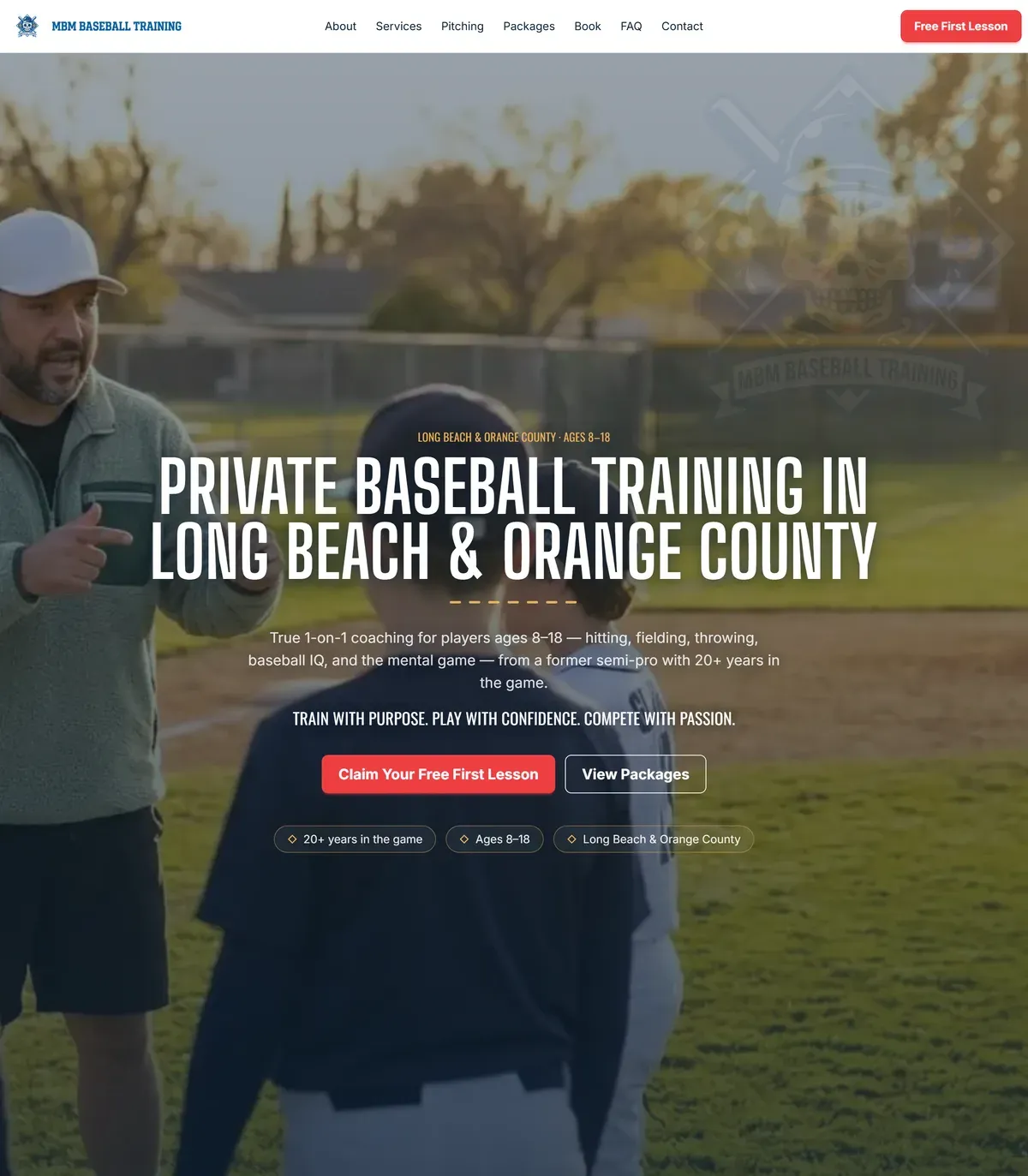
I spent three hours on the phone with Myles getting it exactly how he wanted, and he controls every inch of it. Today, his Google Business Profile ranks first for "private baseball training long beach." That's what a website is supposed to do: put you first the moment someone's ready to book.
That's the case against a marketing agency. They sell you a template, bill you every month, and move on, and you're left paying for a site that looks finished and never does the one job you needed it to. You don't need an agency. You need a site that works, and someone who stays to keep it working.
Questions
Why pay up front when the subscription website platforms for martial arts schools charge monthly?
Because of what happens when you stop paying. With most rented sites, cancelling means the site goes with the vendor. This build is the same fixed pricing as every build, published on the pricing page, and what you buy you own: the domain, the site, everything on it. The only monthly product here is the optional care plan for hosting and upkeep, cancel anytime, and cancelling it never takes the site with it.
Can I keep Kicksite, Zen Planner, or Gymdesk for billing, attendance, and belt tracking?
Yes. Plenty of schools run their whole operation in martial-arts management software, and a website should work with it, not replace it. The site embeds or links straight into the flow you already run: trial signups feed the system you use today, and members reach their portal from your own domain. Nothing changes about how you get paid or how belts get tracked. The site's job is getting more people to that flow.
Should I actually publish prices and the schedule? Most schools around me don't.
That is the argument for doing it. This vertical's own prospects name hidden pricing and missing schedules as reasons they move on, and a parent comparing schools at night will not call to fill in the blanks. The studio publishes its own pricing for the same reason. You decide where prices appear and at what level of detail. The point is that a motivated parent never hits a dead end where a number should be.
Most of my students are kids. Can the site be built around parents searching for kids' classes?
Yes, and for a kids-heavy school it should be. The buyer for a kids' program is a parent doing research after bedtime, so the kids' pages answer a parent's questions: which style, what ages, which days, what it costs, and what the first class looks like. The trial form asks for the child's age and program interest, and the search structure targets the kids-karate-in-your-city queries parents actually type.
I run the school part-time and I'm on a budget. Is a real website worth it over posting on social media?
Social posts mostly reach people who already follow you. A search presence reaches the parent who has never heard of the school yet, which is the audience a follower feed cannot start. The honest budget answer is that pricing here is fixed and published, so you see the entire cost before a single call, and a one-page build exists for schools that need a findable starting point rather than a full site. There is no open-ended retainer, and the optional care plan is the only monthly piece, cancel anytime.
Have you built for martial arts schools before?
The live proof is a session-based sports coaching business: MBM Baseball Training, rebuilt and running, with programs, packages, and a booking path that provably reaches the coach, because the old form had been failing silently and the rebuild fixed it. Coach-led instruction sold by program is the same shape as a school's business. The martial-arts-specific parts, Kicksite, belt tracking, trial-class offers, are new names on a pattern the studio has already shipped.
I don't see my industry here.
The studio builds for every business, in any industry. Industry pages just go deeper where I can speak the language. Browse the industries page or book a call and tell me what you run.
What it costs
Book a 15-minute callNot your industry? I build for every business
Want to show up in local search? Local SEO