Fitness and personal trainer website design that fills sessions.
Trainers sell trust and results. The site's job is simple: introduce the coach, prove the results, and book the session before the visitor's attention moves on. This is the industry where the studio has live, checkable proof.
Where training sites lose clients
Forms that quietly die
The hardest failure to spot is the booking form that stops reaching you. The site looks fine, visitors submit, and nothing arrives. I found exactly this on a real client's site, and nobody had noticed from the outside.
Templates that never name the coach
Generic benefit bullets, stock athletes, and a line about years of experience: nothing a parent or client can attach trust to. People book a coach, not a layout.
Unbookable from a phone
Parents book between things, from phones. If the schedule, the offer, and the booking button are not thumb-reachable, the session goes elsewhere.
Amenity lists instead of outcomes
Gym and facility sites list equipment. Clients buy outcomes: who trains here, what improves, and how to start.
What your business gets
A booking path that provably works
Forms and booking tested end to end before launch, on a phone, with submissions landing where you will actually see them.
Coach-first storytelling
Your name, your face, your story. The rebuilt MBM site leads with Coach Myles, and that is the pattern: people first.
Programs and schedules that stay current
Sessions, programs, and offers structured so updating them is an edit, not a project.
Local SEO
Built to show up where clients actually search for training in your area.
Fast everywhere
Edge-hosted and lean, because a slow site reads like a slow operation.
Case study: MBM Baseball Training
MBM's old site looked professional, and it was quietly costing Myles customers. Parents were filling out the booking form, and the requests never reached him. It never introduced him, either. No name, no face, no story. I rebuilt it around a booking path that actually works and a homepage that leads with Coach Myles himself.
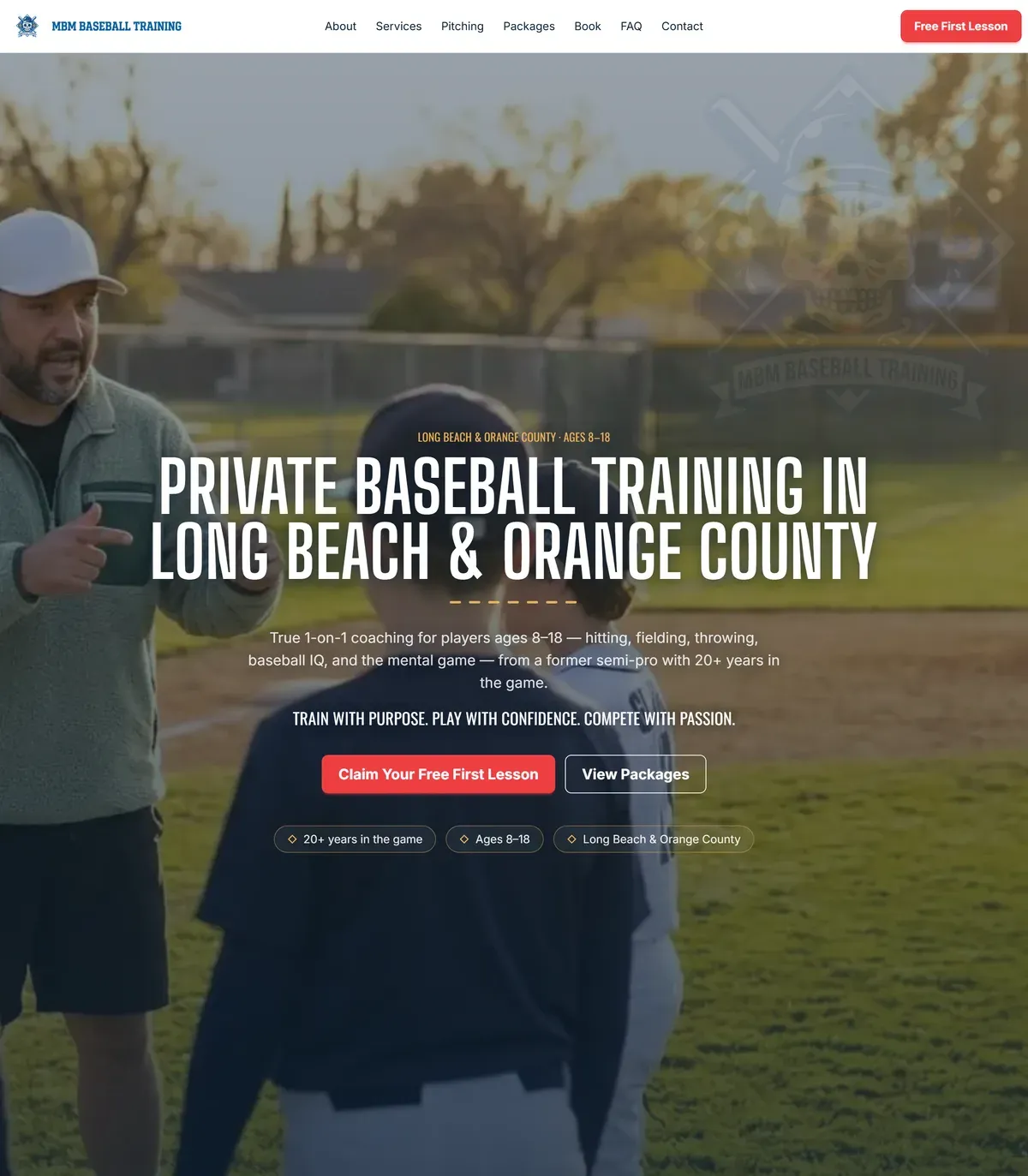
I spent three hours on the phone with Myles getting it exactly how he wanted, and he controls every inch of it. Today, his Google Business Profile ranks first for "private baseball training long beach." That's what a website is supposed to do: put you first the moment someone's ready to book.
That's the case against a marketing agency. They sell you a template, bill you every month, and move on, and you're left paying for a site that looks finished and never does the one job you needed it to. You don't need an agency. You need a site that works, and someone who stays to keep it working.
Questions
Do you build websites for sports training facilities?
Yes, that is where the proof lives: MBM Baseball Training is a private baseball training business, rebuilt and live. Facilities with coaches, programs, and bookings are exactly the shape this studio builds best.
What does a trainer or gym website cost?
The same fixed pricing as every build, published on the pricing page. A one-page build exists for solo trainers starting out.
Can clients book and pay online?
Booking, yes, through whatever scheduling you use or a simple direct flow. If you take payments through your booking tool, the site routes clients straight into it.
How is this different from a template site?
The MBM case study is the honest answer: the old site was professionally built and looked fine, and its booking form was quietly failing. Custom means the parts that matter are built and tested, not assumed.
I don't see my industry here.
The studio builds for every business, in any industry. Industry pages just go deeper where I can speak the language. Browse the industries page or book a call and tell me what you run.
What it costs
Book a 15-minute callNot your industry? I build for every business
Want to show up in local search? Local SEO